Content marketing is not just about publishing regularly. It is about publishing with purpose.
Many businesses create content because they feel they need to stay visible. They post on social media, write articles, follow trends, and try to stay active across different platforms. But without a clear strategy, content can quickly become a lot of effort with very little return.
One of the most important distinctions in content marketing is the difference between evergreen content and trending content.
Both can be valuable. Both can attract attention. But they do not serve the same purpose.
Understanding how to use them properly can help your business build long-term visibility while staying relevant in the moment.
What Is Evergreen Content?
Evergreen content is content that remains useful over time.
It is not tied to a specific date, trend, event, or temporary conversation. People can read it today, in six months, or even in two years and still find value in it.
Examples of evergreen content include:
- How to create a successful Google Ads campaign
- Why your website is not converting visitors into leads
- How to use AI in your marketing
- The basics of SEO for small businesses
- How to build a strong brand strategy
- What to include on a high-converting landing page
This type of content answers recurring questions that your audience keeps asking.
Evergreen content works like a long-term asset. Once created, it can continue to bring traffic, educate prospects, support your sales process, and strengthen your authority.
For a business, this is extremely valuable because the content keeps working after it is published.
What Is Trending Content?
Trending content is content connected to what is happening now.
It can be based on:
- Industry news
- New platform updates
- Social media trends
- Cultural moments
- New tools
- Algorithm changes
- Seasonal events
- Popular conversations
Examples of trending content include:
- What the latest Google Ads update means for advertisers
- How a new AI tool can help marketers save time
- What businesses can learn from a viral campaign
- Instagram’s newest feature and how brands can use it
- Marketing lessons from a current event
Trending content is useful because it captures attention quickly.
When people are already talking about a topic, your business can join the conversation and become part of the moment.
However, trending content usually has a shorter lifespan. It may perform well today, but lose relevance quickly once the topic is no longer popular.
The Main Difference Between Evergreen and Trending Content
The easiest way to understand the difference is this:
Evergreen content builds long-term authority.
Trending content creates short-term visibility.
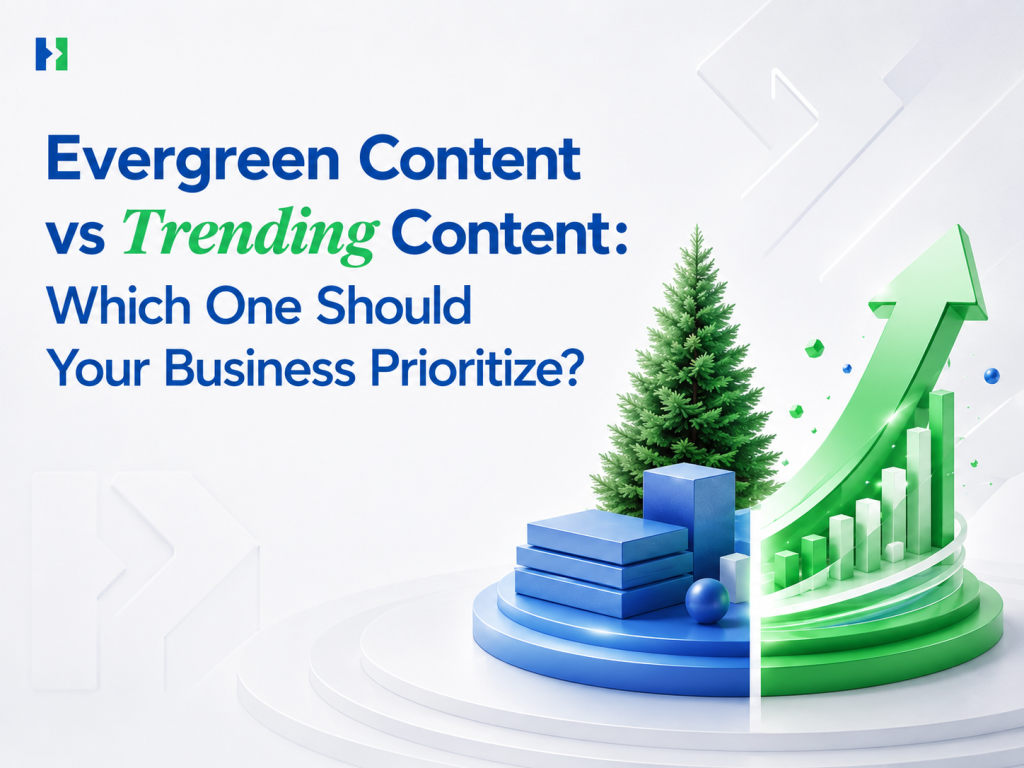
Evergreen content is like planting a tree. It takes time to grow, but once it becomes strong, it provides value for a long period.
Trending content is like catching a wave. It can move fast and create strong momentum, but only for a limited time.
A strong content strategy should not choose one and ignore the other. It should use both intelligently.
Why Evergreen Content Matters
Evergreen content is essential because it creates a solid foundation for your marketing.
It helps your business:
- attract organic traffic from search engines;
- answer common customer questions;
- educate potential buyers;
- build trust before a sales conversation;
- support email campaigns;
- provide material for social media repurposing;
- position your brand as a reliable expert.
For example, if you run a digital agency, an article like “How to Build a Website That Converts” can support your business for months or years.
You can use it in different ways:
- publish it on your blog;
- turn it into LinkedIn posts;
- transform it into a carousel;
- use it in a newsletter;
- send it to prospects;
- include it in your sales process.
This is why evergreen content is powerful. It does not disappear after one post. It becomes part of your marketing ecosystem.
Why Trending Content Matters
Trending content is important because it keeps your brand current.
It shows that your business understands what is happening in your industry and can react quickly.
For example, if Google launches a major search update, a digital agency can publish content explaining:
- what changed;
- who is affected;
- what businesses should do;
- what mistakes to avoid.
This type of content positions the agency as active, informed, and relevant.
Trending content can also increase engagement because people are already paying attention to the topic.
It works especially well on platforms like:
- LinkedIn;
- Instagram;
- TikTok;
- X;
- newsletters;
- short-form video platforms.
However, trending content should not be produced just to follow the crowd. It should always connect back to your expertise, your audience, and your business goals.
The Risk of Only Creating Evergreen Content
Evergreen content is valuable, but relying only on it can make your brand feel too static.
If your business only publishes timeless educational content, you may miss opportunities to join important conversations.
Your audience may also feel that your brand is not fully connected to current market changes.
For example, an agency that talks about SEO but never comments on AI search, Google updates, or changing user behavior may appear less relevant.

Evergreen content builds depth.
Trending content adds movement.
You need both.
The Risk of Only Creating Trending Content
The opposite problem is also common.
Some brands only chase trends.
They react to every new tool, every viral post, every platform update, and every social media format.
This can generate visibility, but it creates a fragile content strategy.
Why?
Because trending content expires quickly.
A post about a platform update may be useful for a few days or weeks. After that, it loses value.
If your entire strategy depends on trends, you constantly need to produce more content to stay visible.
There is no long-term foundation.
This creates pressure, inconsistency, and content fatigue.
The Best Strategy: Combine Both
The strongest content strategies use evergreen content as the foundation and trending content as the accelerator.
A simple model could look like this:
- 70% evergreen content
- 30% trending content
This balance works well for many businesses because it allows you to build long-term visibility while staying relevant.
Evergreen content answers the questions your audience always has.
Trending content connects your expertise to what people are paying attention to right now.
Together, they create a stronger system.
Example for a Digital Agency
Let’s say your agency wants to talk about Google Ads.
Your evergreen content could be:
“Google Ads Mistakes That Burn Your Budget”
This article remains useful because businesses will always want to avoid wasting ad spend.
Then, if Google releases a new Ads feature, your trending content could be:
“What Google’s Latest Ads Update Means for Small Businesses”
The trending post captures immediate attention.
Then, inside that post, you can link back to your evergreen article about Google Ads mistakes.
This creates a smart content path:
Trending topic → attention
Evergreen article → education
Service page → conversion
That is how content becomes a business asset.
How to Create Strong Evergreen Content
To create effective evergreen content, start with the questions your audience asks repeatedly.
Look at:
- sales calls;
- client emails;
- website inquiries;
- FAQs;
- search queries;
- comments on social media.
Then turn those questions into clear, useful articles.
Good evergreen content should be:
- specific;
- practical;
- well-structured;
- easy to understand;
- optimized for search;
- updated regularly.
Avoid vague topics like:
“Marketing Tips for Businesses”
Choose stronger, more specific topics like:
“How to Know If Your Website Is Losing Leads”
Specific content performs better because it speaks directly to a real problem.
How to Use Trending Content Properly
Trending content should not be random.
Before creating it, ask:
- Is this trend relevant to our audience?
- Can we add a useful perspective?
- Does it connect to our expertise?
- Can it support one of our offers?
- Will it help build trust?
If the answer is no, the trend may not be worth your time.
A good trending post does not simply repeat the news. It explains what the news means for your audience.
For example, instead of saying:
“A new AI tool has launched.”
Say:
“What this new AI tool changes for small business marketing teams.”
That angle is more useful, more strategic, and more connected to your audience.
How to Repurpose Evergreen Content
One of the biggest advantages of evergreen content is that it can be repurposed many times.
A single blog article can become:
- a LinkedIn carousel;
- three short posts;
- a newsletter;
- a video script;
- an Instagram Reel;
- a checklist;
- a sales email;
- a lead magnet.
This allows your business to get more value from each piece of content.
Instead of constantly creating from zero, you build from a strong foundation.
For example, an article about website conversion can become:
- “5 signs your website is losing leads”
- “Why visitors leave your website without contacting you”
- “What every service page should include”
- “Before redesigning your website, check this”
This makes your content production more efficient and more consistent.
How to Measure Evergreen and Trending Content
Evergreen and trending content should not be measured in the same way.
Evergreen content should be measured by:
- organic traffic;
- search rankings;
- time on page;
- lead generation;
- backlinks;
- long-term conversions.
Trending content should be measured by:
- reach;
- engagement;
- shares;
- comments;
- speed of response;
- short-term traffic spikes.
If you judge evergreen content too quickly, you may stop before it has time to grow.
If you judge trending content too late, you may miss the real value of the moment.
Each type of content has its own rhythm.
Common Mistakes to Avoid
Many businesses fail with content because they make one of these mistakes:
Publishing without strategy
Posting regularly is not enough. Every piece of content should have a role.
Creating only educational content
Education is important, but content should also guide people toward action.
Chasing every trend
Not every trend deserves your attention. Relevance matters more than speed.
Ignoring SEO
Evergreen content should be optimized so it can be found over time.
Forgetting conversion
Content should not only attract attention. It should help move prospects closer to a decision.
Conclusion
Evergreen content and trending content are not competitors.
They are complementary.
Evergreen content gives your brand stability, authority, and long-term visibility.
Trending content gives your brand speed, relevance, and immediate attention.
The best strategy is to use evergreen content as your foundation and trending content as your amplifier.
Businesses that understand this balance can create content that does more than fill a calendar.
They create content that attracts, educates, builds trust, and supports growth.
In the end, strong content is not about choosing between what lasts and what is popular.
It is about knowing when to use each one.